Continuous Improvement in Manufacturing: Process Excellence Frameworks

Continuous improvement in manufacturing is the ongoing, systematic effort to make processes, quality, and efficiency better over time through small, incremental changes.
“Plan your work, work your plan” is a core mantra in continuous improvement that involves forethought and planning, as well as a commitment to executing your business process.
In this article, you’ll learn:
- What continuous improvement in manufacturing means
- The benefits of the continuous improvement process
- The core frameworks that power process excellence
- The role of digital transformation in continuous improvement
Download your free Root Cause Analysis 101 Guidebook for an overview of common root cause analysis tools, plus tips and tricks for making them more effective
Read how digital transformation helps to continuously improve manufacturing
What Is Continuous Improvement?
Continuous improvement (CI) in manufacturing, or continuous process improvement, involves regularly identifying inefficiencies, eliminating waste, and refining operations to achieve higher productivity and quality.
Originating from philosophies like Kaizen and the Toyota Production System (TPS), CI treats perfection as an ongoing journey, instead of a destination. Rather than one-time fixes, it’s a culture of constantly finding ways to reduce waste, lower costs, and improve product reliability.
At its core, continuous improvement in the manufacturing industry:
- Focuses on eliminating waste (Muda), unevenness (Mura), and overburden (Muri)
- Relies on data-driven methods like Lean, Six Sigma, TQM, and the Theory of Constraints
- Uses cycles like PDCA (Plan–Do–Check–Act) and DMAIC (Define–Measure–Analyze–Improve–Control) to test, learn, and standardize.
Benefits of Continuous Improvement
Continuous improvement means that the longer you do it, the more benefits you’ll see, such as:
Increased Productivity
Constantly streamlining the entire production process becomes an exercise in maximizing efficiency for the best results. Eliminating unnecessary steps or developing better processes reduces cycle times and increases output.
Reduced Waste and Costs
Increased productivity also leads to lower production costs. By cutting down non-essential tasks, you lower your inventory and defect-related expenses.
Higher Product Quality
It’s no surprise that a culture of continuous improvement leads to higher-quality products and services. With fewer defects and an internal system that’s built to monitor, catch, and fix production issues as soon as they arise, your organization becomes more agile and flexible, allowing you to inch towards the competitive edge.
Better Employee Engagement
Everyone likes to know that their opinion matters. Employees who are rewarded for their input are more empowered to take ownership of issues when they arise.
Listening to frontline workers by involving them in continuous improvement activities builds a stronger sense of ownership and care, which leads to better retention, engagement, and satisfaction. This creates a positive work environment that reinforces ongoing participation, and over time, these incremental improvements can reduce production costs and increase efficiency.
Lean Manufacturing in Continuous Improvement
Lean manufacturing, or simply “lean”, sits at the center of continuous improvement. Lean systematizes continuous improvement by giving you the principles, tools, and structure to turn the CI mindset into real, measurable gains in efficiency, quality, and cost on the shop floor. Originating from the Toyota Production System (TPS) in post-WWII Japan, the main goal of lean is to eliminate waste, or the 3Ms:
- Muda: Activities that don’t create value for the end product or customer
- Mura: Unevenness in production levels
- Muri: Overburden of workers and processes
Lean encompasses a wide variety of tools to reduce waste and improve product quality and efficiency, including Jidoka, value stream mapping, poka-yoke, and, most importantly for CI, Kaizen.
Kaizen Methodology: Employee-Led Continuous Improvement
Kaizen is a Japanese word that translates to ‘improvement’. It is a quality philosophy that promotes continuous refinements through small, incremental changes that add up over time.
This practice empowers employees to identify opportunities for improvements in the production process, no matter how seemingly small. By implementing these small process tweaks, employees contribute to compounded positive results over time.
When fully adopted by an organization, lean and kaizen become the elements of a unifying philosophy that drives how the company operates and addresses problems. This promotes a high standard of quality.
Continuous Improvement Tools and Techniques
These methodologies provide structured paths to continuous process improvement:
The Six Sigma Methodology
Developed by Motorola engineer Bill Smith in 1986, and since adopted by leading companies like GE, Ford, and Honeywell, the Six Sigma methodology is a data-driven methodology focused on minimizing defects and variation. It’s built on the DMAIC cycle, which stands for define, measure, analyze, improve, and control, emphasizing systematic approaches to quality.
This methodology centers on applying data and statistical analysis to process control.
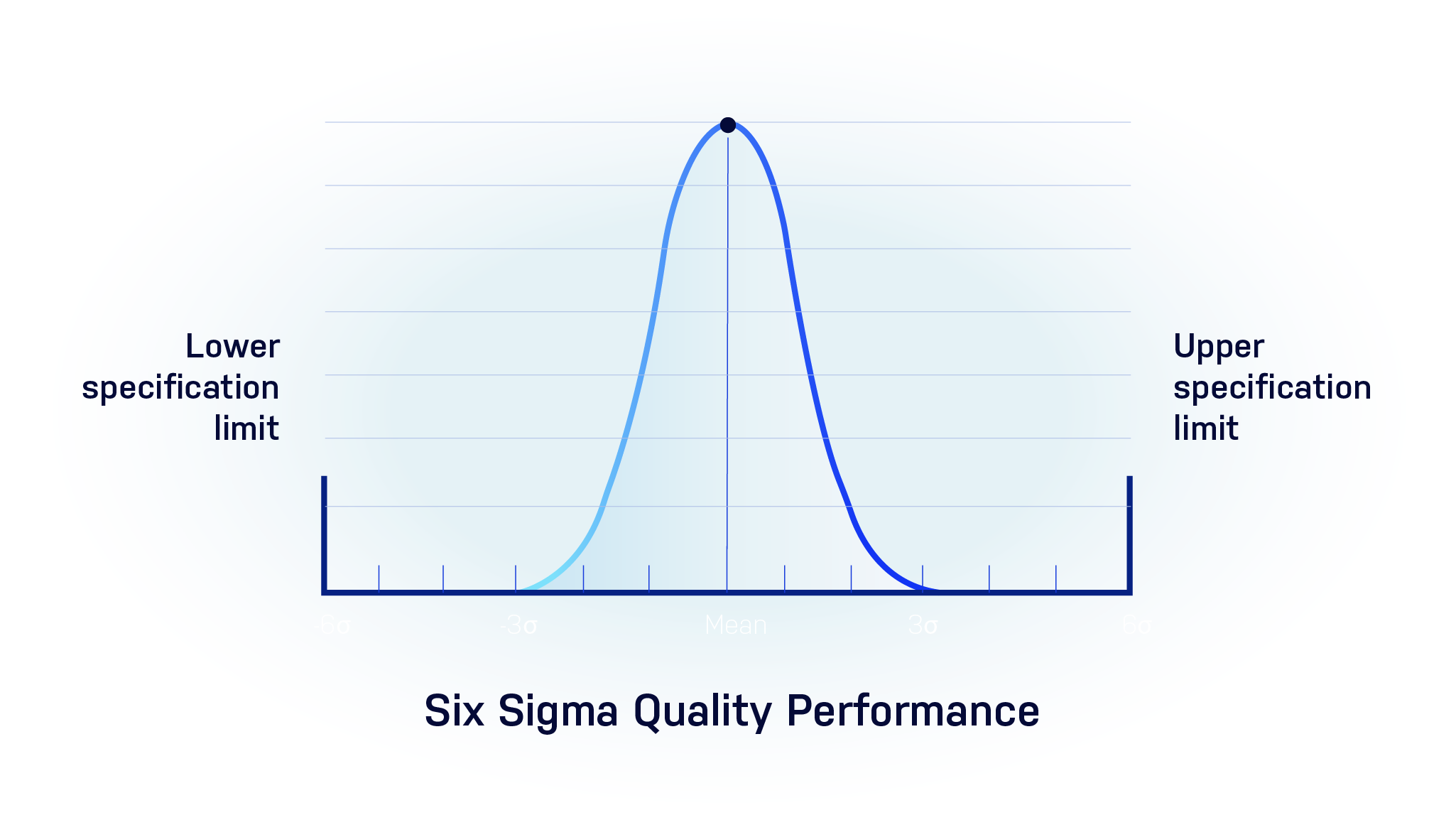
Six Sigma refers to the number of standard deviations or sigma around the mean under a normal distribution (bell curve). Achieving Six Sigma quality equates to a defect rate of 3.4 parts per million, or nearly defect-free processes.
Total Quality Management
Total quality management (TQM) is a comprehensive framework for continuous improvement originally developed by W. Edwards Deming, one of the founding fathers of quality management. It focuses on statistical process control, data-driven decision-making and organization-wide participation in quality.
TQM is centered on the Plan-Do-Check-Act (PDCA) process approach:
- Plan: Setting objectives, defining and documenting processes and standards
- Do: Implementing processes, conducting employee training, executing projects
- Check: Collecting data to measure KPIs against objectives to identify trends and evaluate effectiveness, such as with layered process audits (LPA)
- Act: Taking action based on data collected in the check phase, including adjusting processes and implementing corrective action

Theory of Constraints
The Theory of Constraints is a management philosophy that improves efficiency by eliminating bottlenecks that stand in the way of continuous improvement efforts.
Emerging as a response to the limitations of traditional management techniques, it takes a more holistic approach to improving system-wide effectiveness, focusing on the most critical issues.
The philosophy was first presented by physicist and management expert Eliyahu M. Goldratt in 1984, and has since been widely adopted by many manufacturing organizations.
How to Implement Continuous Improvement
Treating CI as a cyclical process rather than a one-time project helps shift the employee mindset and avoids closing the door on innovation. The CI process should follow these steps:
Understand what you want to achieve
It’s time to map out your goals and identify areas for improvement. Whether it’s Six Sigma’s DMAIC Cycle that starts with Define, or TQM’s process mapping techniques, CI frameworks essentially all have the same starting point: define the problem.
Assemble your team
Process improvements require cross-team collaboration. Everyone, from frontline workers to the executive team, should be involved. This pool of experience is helpful when developing company-wide process improvements.
Implement and test improvements
Define the process that needs optimizing, assemble your team, and implement the changes. Once that is done, monitor and compare your outcomes against predefined KPIs (faster cycle times, improved OEE, reduced downtime, etc.), and adjust the changes as needed.
Standardize improvements
Consider your improvements a success if they meet your initial objectives. Make it official by updating your organization’s SOPs to include them. Encourage employees to adopt the new processes through training, monitoring, and auditing.
Look for new opportunities
The cycle never stops. Continue asking your shop floor workers to share their insights about the machinery, processes, and workflows they use every day, as their experiences are the most valuable. Ensuring that continuous improvement is a well-established initiative avoids stagnation and keeps the cycle alive.
The Role of Digital Transformation in Continuous Improvement Culture
Digital transformation has become the engine driving continuous improvement. Thanks to innovations like AI, connected sensors, integrated systems, and real-time analytics, organizations can automate and optimize waste reduction, failure predictions, and overall decision-making at scale.
Here are real-life examples of how digital transformation drives ongoing improvement and gives forward-thinking companies a competitive edge:
AI & Machine Learning
Manufacturers in particular are focusing on AI for a wide variety of use cases, such as:
- Supply chain optimization
- Predictive maintenance
- Transportation and logistics
- Process improvement
- Quality control
Wayfair, for instance, was an early adopter of AI, applying the technology to logistics and shipping. The company’s ability to continuously adjust which products it sent to different ports helped reduce inbound logistics costs amid pandemic-driven demand fluctuations.
Cloud Computing & LPA Software
Gartner predicts that by 2026, cloud computing will be the underlying platform for 75% of organizations. The ability to store data in the cloud, rather than manage costly on-premise manufacturing software systems, means organizations can deploy various applications while maintaining a comparatively small IT footprint.
Applications range from enterprise platforms like manufacturing operations management (MOM) and enterprise resource planning (ERP) software, to industry-specific solutions like layered process audit (LPA) software.
As an example, one global tire manufacturer uses LPA non-conformance findings to trigger a fast look across all related machinery using custom tags in the audit question library. This quick response lets them quickly identify systemic issues with an outsized impact on quality.
Watch Our Free Webinar on LPA Improvement
IIoT and Edge Computing
Industrial Internet of Things (IIoT) sensors in plant devices are a core digital transformation catalyst in manufacturing applications, such as predictive maintenance, inventory management, and equipment optimization.
Edge computing, which refers to data processing near its source (the network edge), has also expanded manufacturer capabilities around harnessing production data to drive continuous improvement.
Automotive manufacturers use IIoT sensors on machinery to monitor performance data at the edge, enabling real-time insights that help detect issues early, reduce downtime, and improve plant floor decision-making.
Connected Frontline Worker Technology
LNS Research reports that manufacturers are achieving big success with connected frontline worker technology, with four in five transformation leaders achieving meaningful corporate value from implementation.
Connected worker technology encompasses a suite of tools used for improving quality and efficiency, including:
- Digital procedure checklists, remote engineering support, and troubleshooting guides to give operators on-the-spot access to vital information
- Software applications for conducting digital shop floor audits and inspections
- Bi-directional communication tools, such as instant messaging, that connect operators with added support and real-time answers to questions
Achieve Continuous Improvement in Manufacturing Through Process Improvement
Each of the frameworks discussed at the top of this article provides a roadmap for the journey, empowering you to implement continuous process improvements, remove workflow bottlenecks, and improve quality and customer satisfaction.
Plan your work, work your plan, and be ready to adapt along the way.